
How to Choose the Right Servo Motor
Choosing the right servo motor is not a catalog exercise. It is a decision about load, motion, and operating conditions. The International Energy Agency’s report, Energy Efficiency Policy Opportunities for Electric Motor-Driven Systems, estimates that motor-driven systems use about 46% of global electricity. That figure covers many motor types, not servo motors alone, but it shows why efficient sizing matters.
Start with the real load. Record its mass, inertia, friction, travel distance, and required cycle time. Then define the speed and torque needed during acceleration, steady motion, and stopping. A motor that meets peak torque may still overheat if its continuous torque is inadequate. Small details matter: a vertical axis needs holding torque, while a belt drive may add friction and reflected inertia. Check the drive, encoder, supply voltage, and mounting space as one system.
Servo-control specialist Gene F. Franklin’s work emphasizes feedback as a core part of control engineering; in practical selection, that means matching encoder feedback and control performance to the motion required. Treat that as a design principle, not a substitute for a verified quotation. Compare candidate motors against manufacturer torque-speed curves and thermal limits, then validate the choice under the actual duty cycle. A spreadsheet can narrow the options. It cannot fully reproduce a machine’s vibration, heat, or changing load. Leave room for testing. The best choice may be less obvious than the largest motor on the shortlist.
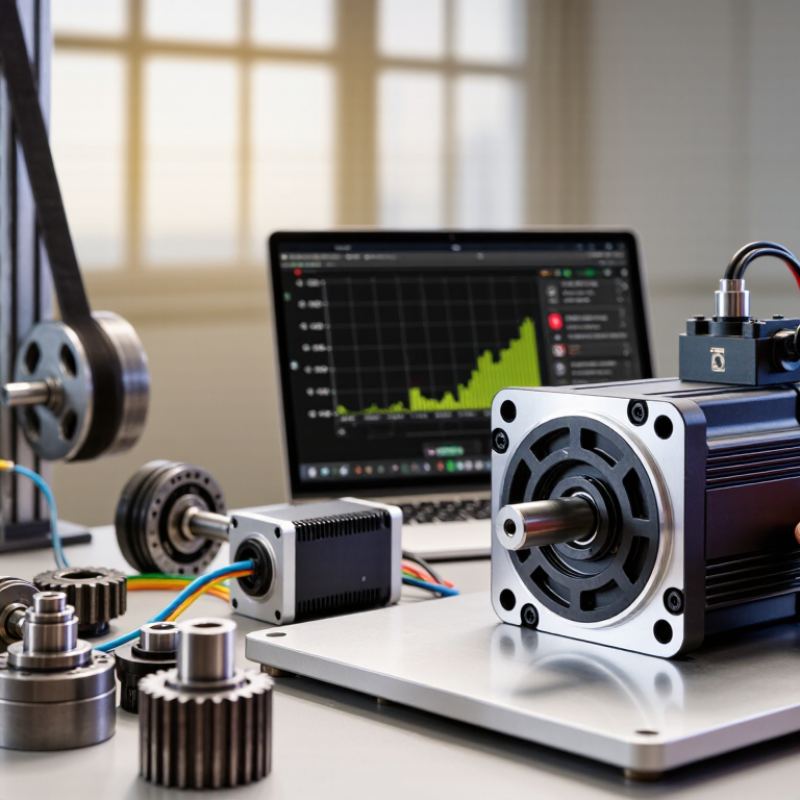
Define the Motion Task and Operating Conditions
How to Choose the Right Servo Motor
Define the Motion Task and Operating Conditions
Begin with the movement the machine must perform. Record travel distance, speed, acceleration, settling time, and how often each cycle repeats. A pick-and-place axis making short, sharp moves has different demands from a conveyor running steadily. Note the payload and moving parts, too; their inertia affects acceleration and braking. Peak torque matters, but it does not describe the full duty cycle. Calculate continuous and RMS torque from the actual motion profile. Measure, don’t guess. The U.S. Department of Energy’s 2014 motor-systems sourcebook reports that motors use about 68% of electricity in U.S. manufacturing. That figure covers many motor types, not servo axes alone, but it highlights why operating efficiency deserves attention.
Then describe the installation, not just the ideal cycle. Record ambient temperature, dust or moisture exposure, mounting position, available voltage, and cable length. Check whether the axis must hold a load during stops or absorb frequent deceleration energy. The IEA’s 2011 report on electric motor-driven systems estimates these systems use 46% of global electricity; the broad figure is useful context, not a servo-specific efficiency claim. Compare the motor’s torque-speed curve with the measured task, and verify that the drive can handle peak current and repeated braking. Leave thermal margin. I still find it easy to overlook a hot enclosure or a heavier fixture added later. A little honest uncertainty is better than sizing from a perfect cycle that never happens.
How to Choose the Right Servo Motor - Define the Motion Task and Operating Conditions
| Motion Task | Example Motion Profile | Load and Mechanical Details to Define | Operating Conditions to Record | Servo Selection Considerations |
|---|---|---|---|---|
| Intermittent indexing table | Rotate 90° in 0.4 seconds, then hold position for 1.0 second; approximately 43 indexes per minute. | Table and workpiece mass; distance from the axis; gearbox ratio; friction; required positioning accuracy. | Cycles per minute, shift length, ambient temperature, and whether the table must hold position during dwell. | Check peak torque during acceleration and deceleration, RMS torque over the full cycle, reflected inertia, and settling time. Use a brake only if the axis must remain secured when power is off. |
| Continuous conveyor | Run at a constant belt speed of 0.5 m/s, with occasional starts and stops. | Belt and roller inertia; conveyed mass; roller diameter; transmission ratio; belt tension and friction. | Continuous or intermittent duty, start-stop frequency, required speed range, and exposure to dust or washdown. | Size for continuous torque and speed, then verify acceleration torque for starts. Consider suitable enclosure protection and thermal capacity for the actual environment and duty cycle. |
| Pick-and-place linear axis | Move 0.5 m in 0.6 seconds, pause briefly, and repeat at about 30 cycles per minute. | Payload plus carriage mass; screw lead or belt pitch; moving orientation; friction; cable-chain forces. | Cycle rate, stroke, required repeatability, vibration sensitivity, and expected operating hours. | Calculate acceleration and deceleration torque, reflected inertia, and RMS torque. Check that the transmission can meet the required speed and that the structure can control vibration and settling. |
| Vertical lift axis | Raise and lower a 25 kg payload through 0.3 m in approximately 1 second per move. | Payload and carriage mass; screw or pulley dimensions; friction; transmission efficiency; possible imbalance. | Move frequency, time spent holding a load, travel limits, and the consequences of losing power. | Include gravity torque as well as acceleration torque. Evaluate a correctly rated holding brake or counterbalance where needed; do not assume the servo motor alone will safely hold a suspended load without power. |
| Rotary winding or web-handling axis | Maintain a target web speed while the roll diameter increases during winding. | Core and roll inertia across the full diameter range; changing mass; tension requirements; transmission ratio. | Continuous duty, speed range, tension variation, ambient temperature, and allowable process interruption. | Check torque and speed at both minimum and maximum roll diameter. Confirm that the drive and feedback system can support the required speed regulation and, where applicable, tension-control strategy. |
Before final sizing: Record the complete motion profile, including travel, speed, acceleration, deceleration, dwell, and cycle rate. Calculate peak and RMS torque using the actual load and transmission, account for reflected inertia and efficiency, and verify motor speed, drive capacity, thermal limits, feedback requirements, and environmental protection. The example profiles are illustrative, not motor-size recommendations.
Related Posts
-
How to Choose an Electric Servo Motor in 2026?
-
How to Choose the Right Industrial Servo Motor?
-
What Is a Direct Drive Servo Motor and How Does It Work?
-

What is an AC Servo Motor and How Does it Work?
-
How to Choose the Right Small Servo Motor for Your Application?
-

How to Choose the Right Industrial Servo Motor for Your Application