How to Choose an Industrial Vacuum Cleaner?
Choosing an Industrial Vacuum Cleaner is less about buying the strongest machine and more about matching its design to the material, workspace, and daily workload. Fine powder, metal chips, liquid spills, and combustible dust place very different demands on filtration, tank capacity, and airflow. A unit that handles a dusty workshop may struggle with long production shifts or delicate equipment. The difference shows up in practical details: a filter that clogs by lunchtime, a hose too narrow for debris, or a machine that cannot safely collect the material on the floor.
Standards offer useful reference points. OSHA’s respirable crystalline silica standard, 29 CFR 1910.1053, sets an eight-hour permissible exposure limit of 50 micrograms per cubic meter and an action level of 25 micrograms per cubic meter. These figures concern workplace exposure, not vacuum performance, but they show why dust control needs careful planning. For combustible dust, consult applicable NFPA guidance and verify that the equipment is suitable for the specific hazard. Product claims alone are not enough.
A sound selection process checks the dust type, required filtration, airflow, static pressure, operating hours, and service access. It also considers noise, mobility, and the cost of replacement filters. Small details matter. A compact unit may fit beneath a workbench, yet fill too quickly during a full shift. I have to admit, specifications can look precise while leaving real-world performance unclear. Ask suppliers for test methods, maintenance requirements, and application references before comparing models.
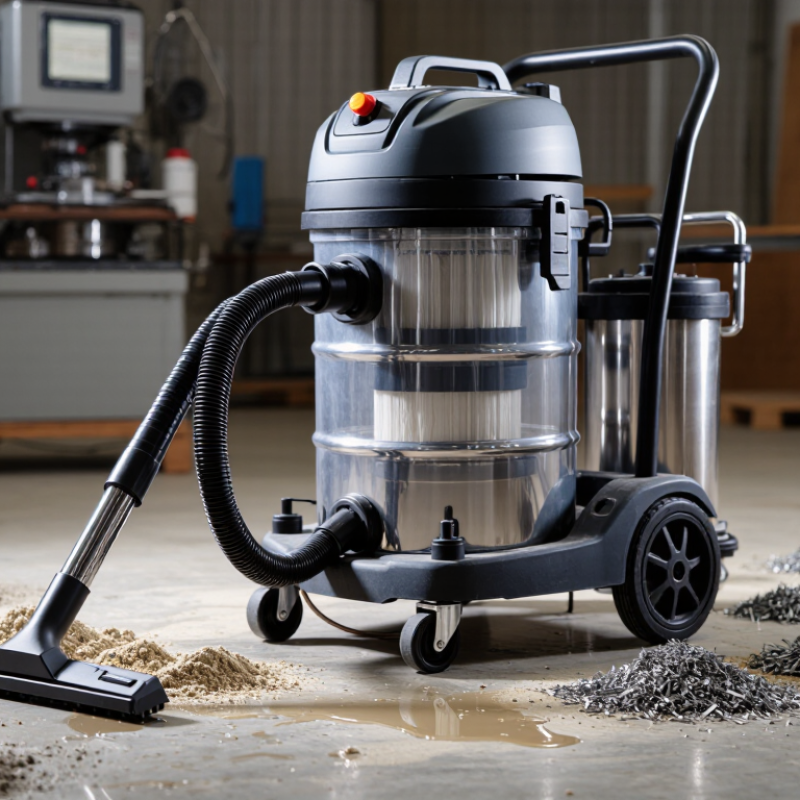
Identify the Cleaning Tasks and Operating Environment
Start by naming the material, not the machine. Fine powder, metal chips, oily liquid, and packaging scraps create different demands. Note particle size, daily volume, and whether debris is dry, damp, or mixed. A handful of fine dust may need tighter filtration than a bucket of coarse shavings. Small details matter.
The operating environment changes the choice. Record floor area, available power, hose distance, and hours of continuous use. Check whether workers clean around hot equipment, narrow machine gaps, or damp floors. For silica-generating work, U.S. OSHA’s respirable crystalline silica standard sets an eight-hour permissible exposure limit of 50 micrograms per cubic meter and an action level of 25 micrograms per cubic meter. That figure is a useful hazard signal, not proof that a vacuum alone controls exposure. Source: OSHA, 29 CFR 1926.1153. Test the actual setup.
A common planning mistake is choosing by tank capacity alone. A large bin can still clog quickly when fine dust loads the filter. Watch a typical cleanup, including the awkward corners and the final minutes of a shift. Is the machine moved often? Does the operator need to empty it without releasing dust? These observations can expose gaps in a neat specification sheet. Real floors are rarely neat.
How to Choose an Industrial Vacuum Cleaner: Filter Efficiency by Class
EN 1822 minimum efficiencies are measured at the most penetrating particle size (MPPS). Use filter performance as one selection factor: also assess the dust hazard, exposure limits, whether the material is wet or dry, and any combustible-dust risks. The vacuum’s sealing and filter condition affect real-world performance.
Classify the Debris, Dust, and Hazard Levels
Choosing an industrial vacuum starts with identifying what the material actually is. Coarse metal chips, damp slurry, and fine powder behave differently in a hose, filter, and collection drum. Note particle size, moisture, temperature, and whether debris is oily or abrasive. Fine dust can pass through unsuitable filters or escape during emptying. Small details matter. A dusty floor may look harmless, yet the process creating it could require a higher level of containment.
For health hazards, check the substance and its exposure controls before comparing machines. OSHA’s Respirable Crystalline Silica standard sets an eight-hour permissible exposure limit of 50 micrograms per cubic meter, with an action level of 25 micrograms. These figures are exposure limits, not vacuum performance ratings. A vacuum alone does not establish safe exposure. Combustible dust also needs a specific hazard assessment; ordinary equipment should not be assumed suitable. A product label is never enough evidence.
Tips: Collect a small sample and describe where it comes from, how often it appears, and how it is cleaned. Ask suppliers for filter-efficiency data, disposal guidance, and documentation for the identified hazard. If the dust is unknown, pause before choosing. That extra step can feel inconvenient, but guessing is worse.
Compare Vacuum Types, Filtration, and Performance Ratings
Industrial vacuum cleaners differ in what they collect and how continuously they can run. A dry unit suits workshop dust and shavings, while a wet-and-dry model handles occasional liquid spills. Fine or hazardous dust may require a sealed system with filtration matched to the material. Check the filter class and replacement guidance, not just the word “HEPA” on a product sheet. Dust can escape during emptying if the collection method is poorly sealed.
Performance ratings need context. Airflow helps move debris through the hose; static pressure matters when lifting heavier particles or using long hose runs. Compare both figures, along with motor duty rating, tank capacity, and noise level. A high wattage alone does not guarantee stronger pickup. Test conditions vary.
Match the machine to the task. A narrow nozzle may clear dust from a bench, but it can slow cleanup across a broad floor. Consider hose diameter, filter-cleaning method, and how often the tank must be emptied during a typical shift. Ratings can look precise while hiding real differences in setup. I would verify them. If possible, compare machines using the same debris and hose length; a paper specification rarely captures every frustrating detail.
Evaluate Capacity, Mobility, Power, and Required Features
Choosing an industrial vacuum starts with the debris, not the biggest tank on the floor. Fine dust fills a container differently from metal chips or damp sludge, so estimate the volume per shift and leave room for safe emptying. A full 80-liter drum is awkward to move through a narrow aisle. NIOSH’s Revised Lifting Equation uses a 51-pound load constant only under ideal lifting conditions; twisting, long reaches, and repeated handling reduce the recommended load. That makes bin size and emptying method part of mobility planning, not an afterthought. Small detail. It matters.
Match power to the material and hose length. Airflow helps move debris; static pressure helps maintain suction through restrictive hoses and filters. Ask for performance data at the working point, not just motor wattage. For silica-related housekeeping, OSHA’s construction standard specifies HEPA-filtered vacuuming or wet methods in applicable situations (29 CFR 1926.1153). Filter access, sealed disposal, and differential-pressure indicators can make maintenance safer and more predictable. Check wheel size, handle height, and turning clearance on the actual route. A unit that rolls well across a showroom may snag on a floor joint. A little doubt is useful: requirements can change between shifts, so leave practical room for different debris and collection needs.
Check Safety Standards, Maintenance Needs, and Lifetime Costs
An industrial vacuum is a safety control, not just a cleanup tool. Match its dust classification and construction to a documented hazard assessment. Check applicable standards, such as IEC 60335-2-69 for commercial wet and dry vacuums. For combustible dust, verify suitability for the specific environment; ordinary filtration is not enough. The U.S. Chemical Safety Board’s 2006 study recorded 281 combustible-dust incidents, 119 deaths, and 718 injuries from 1980 to 2005. Good suction alone is a poor buying test.
Tips: Ask for filter-efficiency and maintenance records. Check how quickly filters load with your actual dust. A showroom test can miss that.
Compare lifetime costs, not just the purchase price: include replacement filters, bags, energy, service, and downtime. The U.S. Department of Energy reports that motor-driven systems account for about 54% of electricity use in U.S. manufacturing. That figure is not a vacuum’s energy bill, but it underlines why measured power consumption matters. Request expected service intervals and parts prices, then estimate costs over your planned ownership period. Small filters may look economical. They may need frequent replacement. I would still treat any estimate cautiously: real dust, shift length, and operator habits can change maintenance needs.
