
How to Choose the Best Bulk Sorter for Your Business?
Choosing the right Bulk Sorter can improve throughput, reduce manual handling, and protect product quality. But the best machine is not always the fastest one. It must match your material, capacity, and operating conditions. A sorter handling dry grain faces different demands from one processing irregular plastic flakes or mixed-size food products. Particle size, moisture, dust, and feed consistency all matter. Small differences can change performance.
Before comparing models, define what success means for your operation. Note your target throughput, acceptable product loss, sorting accuracy, and available floor space. Ask suppliers how their equipment performs with samples resembling your actual material. A specification sheet helps, but a controlled product test can reveal issues it does not. Watch for bridging in the hopper, uneven distribution on the belt, and frequent cleaning requirements. Details matter.
One source limitation matters: no articles or verifiable expert quotation were provided, so attributing a quote to a named industry expert would risk inventing one. A useful buyer principle is: “Choose the sorter that proves its performance on your material, not just on paper.” Treat it as original editorial wording, not a quotation from a real expert. Be cautious. A reliable comparison should include test conditions, maintenance needs, operator training, and support availability. No sorter is perfect. The right choice is the one your team can run consistently, inspect easily, and maintain without disrupting production.
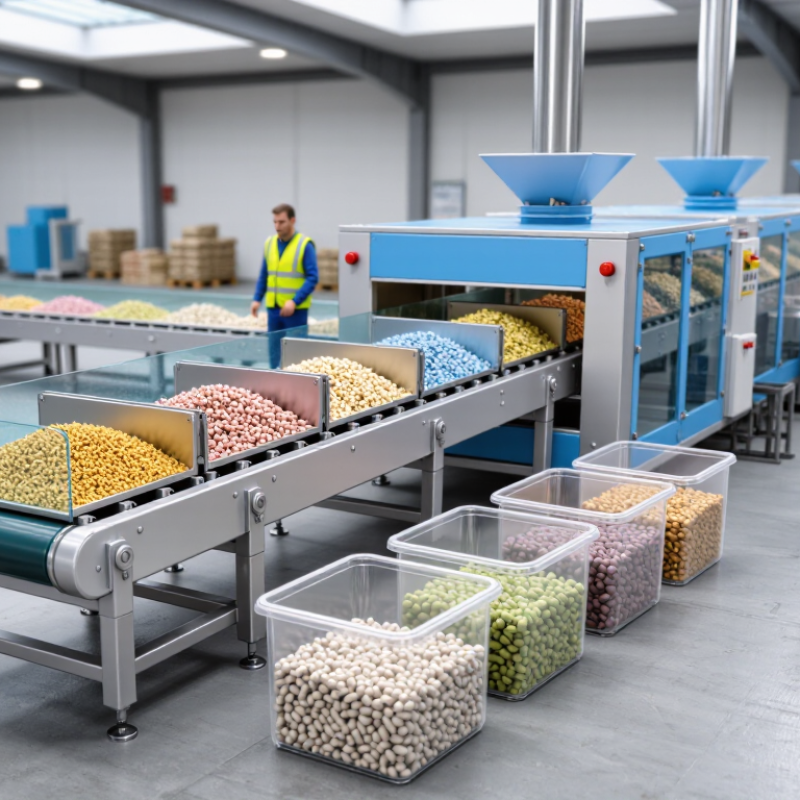
What a Bulk Sorter Is and How It Works
A bulk sorter separates large volumes of loose items by measurable features such as size, shape, color, or weight. A conveyor carries material past sensors, which collect data about each item. The sorter’s control system compares those readings with set criteria. It then directs items into separate paths using air jets, gates, or diverters. For example, a line sorting plastic flakes may identify a color difference and send selected pieces into a side chute. Small settings matter.
Performance depends on the material and the setup. Dust, uneven lighting, overlapping items, and inconsistent feed rates can affect sensor readings. Operators may adjust belt speed, spacing, or detection thresholds to improve separation. A sorter does not automatically fix poor material flow. That matters. Even a capable machine can produce uneven results when items arrive in clumps. Trials with real material can reveal issues that specifications alone may not show.
Tips: Check how accurately the machine handles your actual product, not just sample images or stated capacity. Ask how often sensors need cleaning, and record reject rates during a short production run. Leave room for adjustment; the first settings may not be right. A little uncertainty is normal.
How to Choose the Best Bulk Sorter for Your Business? — What a Bulk Sorter Is and How It Works
| Sorter Type | How It Works | Common Applications | Key Selection Factors | Important Limitations |
|---|---|---|---|---|
| Screen or Sieve Sorter | Uses openings of selected sizes to separate particles according to their dimensions. Vibrating or rotating motion helps material pass across the screen. | Aggregates, grains, powders, compost, and other materials that can be separated by particle size. | Particle-size range, required cut sizes, screen-opening shape, moisture level, and the risk of blinding or blockage. | Separates by size rather than material identity. Wet, sticky, or irregular material can reduce screening effectiveness. |
| Optical Sorter | Cameras or other optical sensors inspect items on a belt or chute. A control system identifies selected characteristics and activates air jets or mechanical diverters to remove or redirect items. | Food products, plastics, minerals, and other discrete pieces with detectable visual or spectral differences. | Material presentation, target defect or material contrast, sensor capability, product size, feed consistency, and acceptable false-reject rate. | Performance depends on items being presented clearly to the sensors. Similar-looking materials may be difficult to distinguish. |
| Air Classifier | Uses a controlled air stream to separate particles based mainly on differences in aerodynamic behavior, which is influenced by size, shape, and density. | Lightweight contaminants, fibers, husks, and selected dry granular or powdered materials. | Particle characteristics, moisture, air-flow control, dust collection, and the desired separation cut. | Not a direct substitute for precise size or composition sorting. Dust management and stable feed conditions are important. |
| Magnetic Separator | Uses a magnetic field to attract and remove ferrous or other magnetically responsive material from a moving product stream. | Mining, recycling, food processing, and manufacturing where removal of ferrous metal is needed. | Material depth, belt or chute arrangement, contaminant size, required field strength, and cleaning method. | Conventional magnetic separation does not remove non-magnetic contaminants such as many stainless-steel grades, plastics, or glass. |
| Eddy-Current Separator | A rapidly changing magnetic field induces currents in conductive non-ferrous metals, creating forces that help separate them from other material. | Recycling streams containing materials such as aluminum and other conductive non-ferrous metals. | Feed size and consistency, metal type, belt speed, particle presentation, and the required recovery or purity. | Best suited to suitable conductive particles; fine, tangled, or poorly presented material can make separation more difficult. |
| Density or Gravity Separator | Uses differences in density, often with air, vibration, or a fluidized bed, to stratify and separate particles. | Seeds, grains, minerals, and other materials with meaningful density differences. | Density contrast, particle-size range, moisture, feed uniformity, and available space for the separation process. | Materials with similar densities may not separate well. Results can be sensitive to changes in feed conditions. |
| Mechanical Diverter or Gate | A gate, flap, or diverter directs material into different discharge paths based on a control signal or process condition. | Routing batches or streams between bins, conveyors, processing lines, or destinations. | Throughput, material abrasiveness, gate response, sealing needs, and integration with upstream controls. | Usually routes material rather than identifying it; a separate sensor or process signal may be needed to determine which path to use. |
Practical selection tip: Define the material, target separation, required throughput, acceptable product loss, and operating conditions first. Then test representative samples under realistic feed conditions and compare separation quality, maintenance needs, energy use, and total operating cost.