How to Choose the Right Small Servo Motor for Your Project?
Choosing the right small servo motor for your project can be daunting. Experts like Dr. Emily Chen, a leading engineer in the robotics field, emphasize the importance of proper selection. She once said, "The right small servo motor makes the difference between success and failure in complex projects."
When looking for a small servo motor, consider its specifications carefully. Factors like torque, speed, and size are crucial. For instance, a high-torque motor may be necessary for heavier loads, while speed becomes vital in fast-paced applications. An improper choice can lead to inefficiencies, or even project failure. This is something many engineers have faced in their work.
Understanding the task your small servo motor must perform is essential. Every detail counts. Sometimes, a small oversight can lead to problems. Be prepared to reflect on your choices as you navigate the process. Evaluating your needs thoroughly will guide you towards a successful selection.

Understanding the Basics of Small Servo Motors and Their Applications
Small servo motors play a crucial role in various applications, including robotics, automation, and model making. Their ability to provide precise control makes them invaluable. Understanding their specifications is essential for any project. Factors such as torque, speed, and size must align with your needs. Small servo motors can be lightweight and compact, but their power output varies widely.
When selecting a motor, consider the load it will carry. An underpowered motor can fail to perform, while an excessively powerful one may cause mechanical stress. Look for feedback mechanisms. They improve precision but also add complexity. Budget constraints may also influence your choice. Opting for a cheaper option might save money upfront but could lead to reliability issues later.
Moreover, consider the environment where the motor will operate. Some motors are not designed for high humidity or temperature variations. Be cautious about the torque ratings. Many users underestimate the force required, leading to unexpected failures. Research the motor’s specifications thoroughly. Seek advice from experts in the field. Making informed decisions can significantly impact the success of your project.
How to Choose the Right Small Servo Motor for Your Project?
| Motor Type |
Torque (kg-cm) |
Speed (s/60°) |
Voltage (V) |
Application |
| Standard Servo |
3.0 |
0.15 |
5 |
Robotics, Hobby Projects |
| Digital Servo |
4.0 |
0.12 |
6 |
RC Vehicles, Drones |
| Coreless Servo |
5.0 |
0.10 |
7.4 |
Competitive Robotics |
| Mini Servo |
2.5 |
0.18 |
4.8 |
Small Robots, Animatronics |
| High Torque Servo |
10.0 |
0.20 |
12 |
Industrial Applications |
Identifying Key Specifications When Selecting a Servo Motor
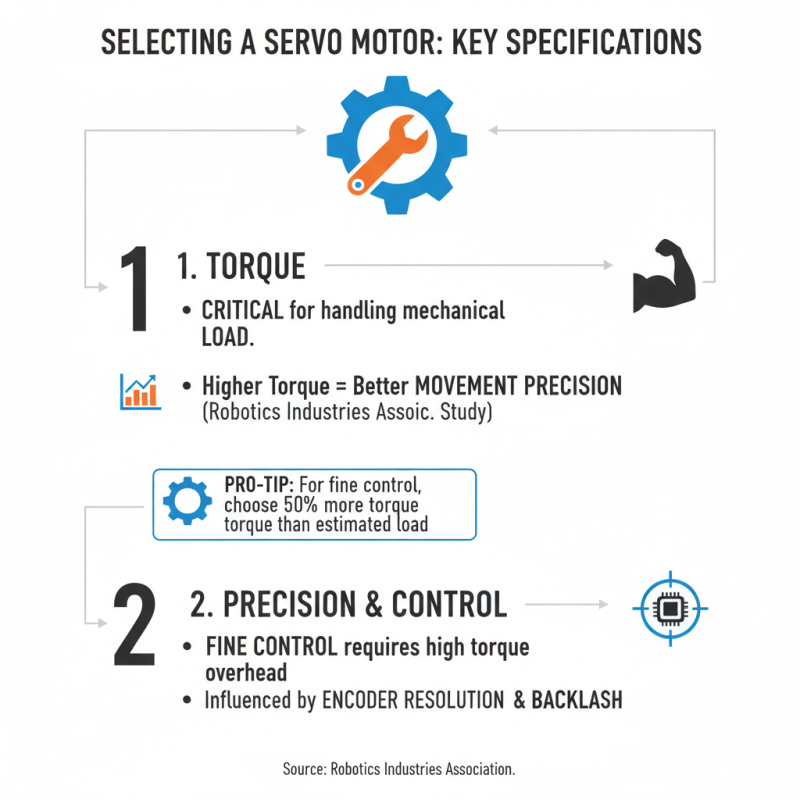
When selecting a small servo motor, key specifications are crucial for optimal performance. Torque is one of the most critical factors. It determines how much load the motor can handle. A study by the Robotics Industries Association indicates that a higher torque rating often correlates with better precision in movement. For applications requiring fine control, choosing a servo with at least 50% more torque than the estimated load is advisable.
Speed is another vital specification. Many projects demand quick response times, which are usually measured in revolutions per minute (RPM). According to the International Federation of Robotics, motors with higher RPM ratings generally provide faster operation. However, this can sometimes compromise torque. Thus, balance is necessary. Additionally, feedback type—such as open-loop or closed-loop—should be considered. Closed-loop systems offer better accuracy and correction capabilities but are often more complex.
Understanding these specifications can help you avoid costly mistakes. For instance, using a motor with inadequate torque may lead to stalling, wasting time and materials. Research shows that project failures often stem from these misjudgments. It's essential to analyze project requirements thoroughly before making a choice. Your decision impacts the overall system reliability and functionality. Addressing these specifications with care can ultimately elevate your project's success.
Evaluating Torque and Speed Requirements for Your Project
When selecting a small servo motor, evaluating torque and speed requirements is critical.
Torque affects how much load your motor can handle. A typical small servo can provide anywhere from 1 to 20 kg-cm
of torque, depending on its design. Understanding your project's weight and resistance is vital. If your application requires lifting heavy objects,
make sure the motor's torque exceeds the load.
Speed is another key factor. Most small servos can achieve speeds ranging from 0.1 to 0.25 seconds
per 60 degrees of rotation. For projects needing fast response times, look for motors at the higher end of this range. A robot arm, for instance,
may require quick movements to operate effectively. Analyzing your workflow and responsiveness needs will help you choose wisely.
Another consideration is the environment where the motor will operate. High temperatures or humidity can impact performance. Sometimes, a servo may not perform
as expected under these conditions. Field data indicates that servo motors can lose up to 30% of their rated torque under
extreme heat. Testing motors under real-world conditions can reveal these imperfections. Addressing these challenges early can save you from project delays.
Assessing the Size and Form Factor of Small Servo Motors
When selecting a small servo motor, understanding size and form factor is crucial. Servo motors come in various dimensions, and the right choice depends on project requirements. Measure the available space in your design carefully. A compact form factor may fit better in tighter spaces but can limit power and torque. Conversely, a larger motor might provide more strength but could be unsuitable for small devices.
Consider the mounting options as well. Different motors have varied shapes, impacting installation ease. A poorly mounted servo can lead to performance issues. Check the orientation of the motor, as it affects gear alignment and functionality. It’s essential to strike a balance between size and performance for efficiency.
Be aware that a smaller servo might not always be the best fit. While it can save space, insufficient torque can inhibit the intended operation. Always test the motor in a prototype before finalizing your selection. This step identifies potential issues early. Size impacts not just the physical space but overall performance and user experience. An informed choice now can prevent significant adjustments later.
Considering Control Methods and Compatibility with Your System
When selecting a small servo motor, it’s essential to consider control methods. There are various options available, including PWM (Pulse Width Modulation) and serial communication. PWM is popular for its simplicity and efficiency. It allows control of position and speed with minimal components. However, it requires precise timing from the controller. For more complex systems, serial communication offers flexibility but may present challenges in programming.
Compatibility is another critical factor. Ensure that the servo motor integrates well with your current system. Check the power requirements and the signal compatibility. This can prevent potential issues during operation. Sometimes, you may notice that even a slight mismatch can lead to performance problems. It’s also crucial to evaluate the physical dimensions of the motor. A perfect fit ensures optimal functionality, especially in space-constricted applications.
Reflect on your project’s specific needs. Test different scenarios to determine which control method offers the best performance. Experimenting with various configurations can reveal unexpected outcomes. Understanding these complexities will enhance your selection process and improve your project's success.