How to Choose a Small Servo Motor for Your Project?
Choosing the right small servo motor is crucial for any project. Experts often remind us of the complexities involved. One notable figure in the field, Dr. Emily Carter, emphasizes, “Selecting a small servo motor is a blend of science and art.” Her insight reveals how thoughtful choices can lead to success.
Many factors contribute to your decision. The torque, speed, and dimensions of the small servo motor all play key roles. It can be overwhelming. Manufacturers often offer a variety of specifications. This makes it easy to feel lost in a sea of options. Understanding your project’s needs is essential.
When evaluating small servo motors, pay attention to details. Measure the space available and consider how much weight this motor needs to move. Do not overlook power consumption. It matters in battery-operated projects. Each decision impacts performance. Reflect on your choices; sometimes, simpler is better.
Understanding the Basics of Small Servo Motors
When selecting a small servo motor, it's essential to grasp some fundamentals. Small servo motors are critical in various applications, from robotics to hobby projects. They provide precise control of angular position. Typically, they consist of a motor, gears, and a control circuit. This combination allows for accurate movement, which is invaluable for projects requiring stable operation.
Understanding specifications is crucial. Torque, speed, and size are vital metrics. Torque measures the motor's rotational force. A higher torque means it can handle more weight. Speed indicates how fast the motor can rotate. It’s important to find a balance between torque and speed for your project needs. The dimensions of the servo motor will also impact its usability in compact spaces.
Make sure your choice meets the project requirements. Sometimes, the specifications on paper look perfect. However, real-world testing can reveal problems. Performance might not match your expectations. This reflection is necessary for successful applications. Always consider current consumption and how it affects your power supply. Efficiency can be an overlooked aspect, but it’s crucial in prolonged applications.
Identifying Your Project's Requirements for Servo Motors
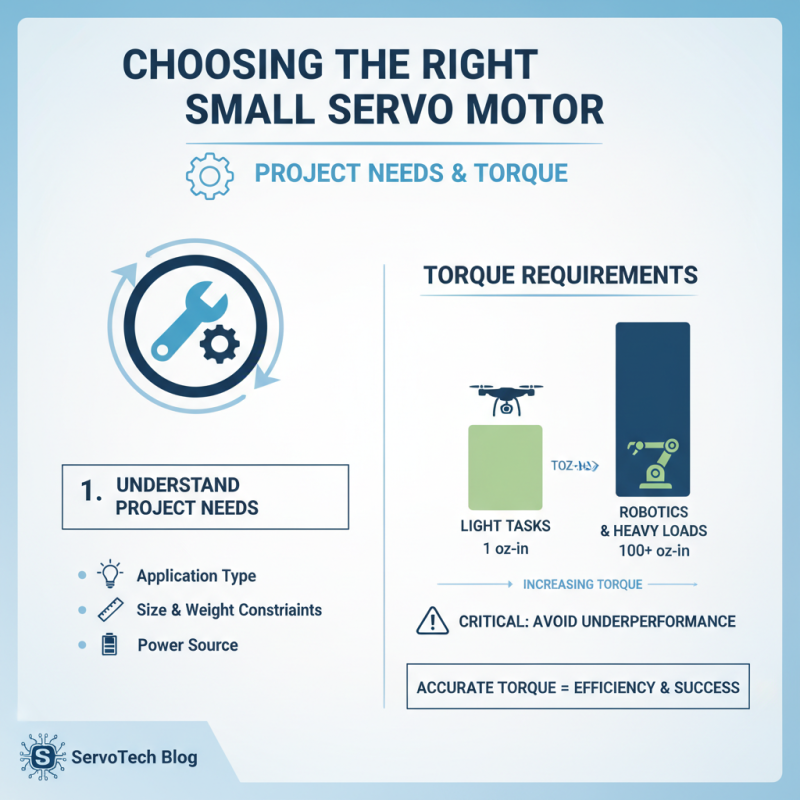
Choosing the right small servo motor begins with understanding your project’s specific needs. The first aspect to consider is torque. According to industry reports, torque requirements can vary from 1 oz-in for light tasks to over 100 oz-in for robotics. Accurately identifying this helps avoid underperformance. A wrong value can lead to inefficiencies and hinder project success.
Next, consider the speed and precision. If your application requires quick movements, a motor with higher RPM ratings is essential. Research indicates that smaller servos can range from 0.1 to 1.5 seconds for a full rotation. Balancing speed and accuracy is vital. Sometimes, quicker isn’t always better. You may need time to adjust and tune motors for optimal performance.
Power supply and size are also critical factors. A small motor might seem appealing, but inadequate power can stall your project. Data shows that over 30% of users underestimate power needs. Evaluate your power requirements carefully. Reflect on your design. Each detail can make a significant difference in the final outcome.
Evaluating Technical Specifications of Small Servo Motors
When selecting a small servo motor for your project, evaluating technical specifications is essential. Begin by looking at the motor's torque rating. This measures the force the motor can exert and is crucial for applications requiring precise movements. A motor with insufficient torque may fail to perform as needed. However, high torque can lead to increased power consumption.
Next, consider the speed of the servo motor. Speed is often measured in seconds per 60 degrees of rotation. A slower motor might be adequate for simple tasks, but it could hinder performance in dynamic applications. Balancing speed and torque is vital.
Pay attention to the motor's PWM range. Different servos respond to different PWM signals. A mismatch might cause erratic movements or the motor to remain unresponsive. Lastly, size and weight matter. A small servo motor packed with features can be excellent, but if it is too heavy, it may affect the overall design of your project.
Evaluate all specifications thoroughly, considering your project's unique needs. Engaging in this process may reveal unforeseen challenges in your project planning.
Comparing Different Small Servo Motor Brands and Models
When selecting a small servo motor, understanding the differences among brands and models is crucial. Recent market reports indicate that there are over 100 small servo motor manufacturers worldwide, each boasting unique specifications. Some motors offer high torque, while others emphasize speed or precision. This variety can make the decision process overwhelming.
One common challenge is aligning motor features with project needs. For instance, a motor with a high torque rating might be ideal for robotics but may not fit well in compact designs. Data shows that more than 30% of engineers regret not considering size constraints when choosing a motor. Many overlook the influence of power consumption. A motor that consumes too much can lead to overheating and inefficiency.
Brands differ significantly in durability and performance as well. Some models can handle 50,000 cycles, while others may fail after just a few thousand. This disparity raises questions. Are the cheaper options actually worth the investment? It's a common dilemma. Thus, careful analysis of user feedback and reliability ratings is crucial before purchasing. Data from industry reviews suggests that proper research can prevent costly mistakes.
How to Choose a Small Servo Motor for Your Project?
| Model |
Torque (kg.cm) |
Speed (sec/60°) |
Voltage (V) |
Weight (g) |
Price (USD) |
| Model A |
2.5 |
0.12 |
4.8 |
10 |
15.00 |
| Model B |
3.0 |
0.10 |
6.0 |
12 |
18.50 |
| Model C |
5.0 |
0.08 |
4.8 |
15 |
25.00 |
| Model D |
1.5 |
0.15 |
5.0 |
8 |
12.00 |
| Model E |
4.2 |
0.09 |
7.4 |
20 |
22.50 |
Installing and Testing Your Chosen Small Servo Motor
Installing a small servo motor correctly is crucial for optimal performance. Begin by reading the manufacturer's specifications. Understand the voltage ratings and torque characteristics. This ensures compatibility with your project. According to industry reports, proper installation increases the lifespan of the motor by up to 30%.
Next, focus on the wiring. Connect the signal, power, and ground pins accurately. A common mistake is reversing these connections, which can damage the motor. Test the connections with a multimeter to confirm accuracy. After wiring, it's time to run a basic test. Use a microcontroller to send simple commands. Observe the motor's response. If it behaves erratically, double-check your connections. The learning curve here is steep, and patience is vital.
Finally, monitor for noise or excessive heat during operation. These signs indicate potential problems. A study found that 15% of servo motors fail due to overheating. Evaluate your setup regularly and be ready to make adjustments. Reflection is necessary to improve your process and extends the motor's longevity in your project.