Why Choose Servo Motors and Drives for Your Industry Needs?
In today’s fast-paced industrial landscape, the choice of automation technologies significantly impacts operational efficiency. Servo motors and drives are at the forefront of this transformation. According to a recent report by Research and Markets, the global servo motors and drives market is expected to reach $12.4 billion by 2027, growing at a CAGR of 6.2%. This highlights the increasing reliance on these systems for precision control and energy efficiency.
Expert in motion control systems, Dr. John Smith, emphasizes, “Using servo motors and drives allows industries to achieve unmatched accuracy and responsiveness.” This reflects a crucial aspect of modern manufacturing, where every detail matters. However, the implementation of these advanced systems can be daunting. Many industries face challenges in adaptation and integration.
Understanding the potential and limitations of servo motors and drives is essential. Enhanced performance often comes with complexity in setup and maintenance. A thoughtful assessment of operational needs is necessary before making the switch. The journey toward automation should be strategic, considering both immediate gains and long-term sustainability.

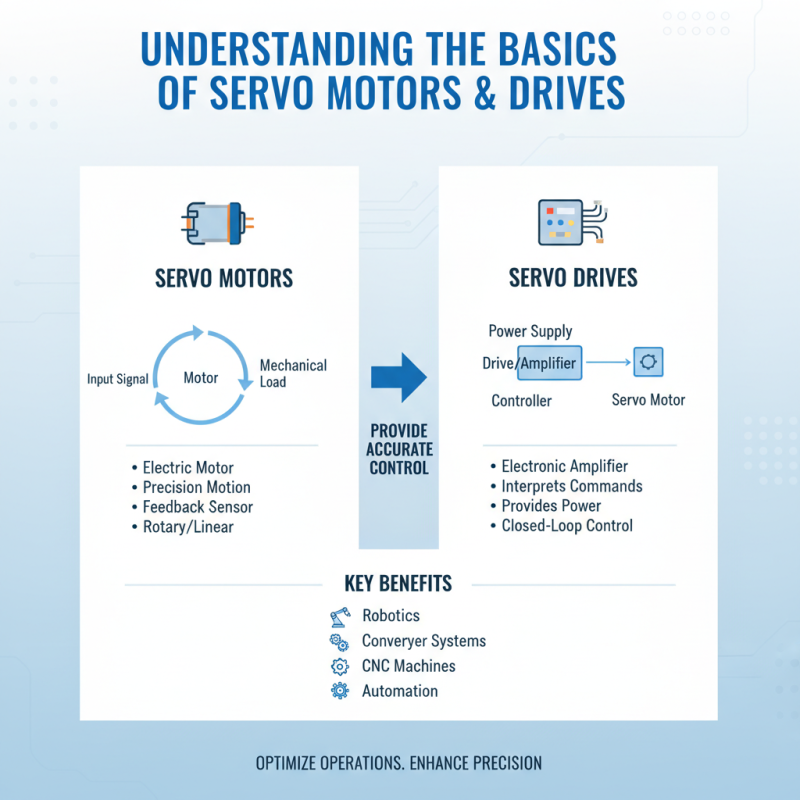
Understanding the Basics of Servo Motors and Drives
Servo motors and drives are crucial components in many industries. They provide precise control over motion and positioning. This accuracy is essential in applications like robotics and conveyor systems. Understanding these basics helps in optimizing operations.
Servo motors convert electrical energy into mechanical energy. They achieve this through feedback loops that adjust performance continuously. This system ensures that the motors respond accurately to commands. However, not all applications require such precision. Assessing your specific needs is vital. Over-specifying can lead to unnecessary costs.
Drives for servo motors vary widely. Some are simple, while others offer advanced features. It’s important to choose based on your operation’s complexity. A simple drive may suffice for basic tasks. Yet, complex operations might need high-performance drives. Balancing cost and capability can be challenging. Taking time to evaluate your requirements is crucial.
Key Advantages of Using Servo Motors in Industrial Applications
Servo motors are increasingly favored in various industrial applications due to their remarkable advantages. These motors provide high precision control, essential for tasks requiring accuracy. For instance, according to a report from the International Society of Automation, servo motors can achieve positioning accuracy within 0.01 mm in advanced robotic applications. This precision significantly reduces manufacturing errors, enhancing product quality.
In addition to accuracy, servo motors offer superior speed and responsiveness. Research from the Motion Control Association highlights that servo motors can accelerate to full speed in mere milliseconds. This rapid response time allows industries to improve efficiency and productivity, particularly in assembly lines. However, it’s crucial to consider that implementing servo technology may require a higher initial investment compared to traditional motors. The pay-off, though, often comes in the form of lower operational costs and reduced downtime.
Energy efficiency is another compelling reason for choosing servo motors. With the ability to minimize energy consumption by 30% or more compared to conventional systems, servo motors are not just environmentally sound; they're economical too. While the transition to servo systems can be daunting, the benefits they bring could outweigh the initial challenges. Adopting them in the right context can lead to substantial operational improvements over time.
Comparing Servo Motors to Other Types of Motors
When considering different types of motors, servo motors stand out due to their precision and control. Unlike traditional AC or DC motors, which may not provide fine position control, servo motors excel in applications requiring accuracy. They can quickly adjust to commands, making them suitable for robotics and CNC machines.
Other motors can be more straightforward. Standard motors are often less complex and easier to maintain. However, they might struggle with high-speed applications. Torque is another critical difference. Servo motors deliver consistent torque across varying speeds. This efficiency makes them ideal for dynamic environments. Yet, they may require more setup for optimal performance.
Cost is always a factor. Servo systems tend to be more expensive upfront. Still, their long-term benefits often outweigh initial costs. Users may need to assess their specific needs carefully. Sometimes, a simpler motor could suffice. However, for applications demanding high performance, servo motors shine as the preferable option. The choice ultimately hinges on the balance of precision, cost, and application requirements.
Industry-Specific Applications of Servo Motors and Drives
Servo motors and drives are increasingly vital across various industries. Their precision and adaptability enhance performance in applications ranging from robotics to CNC machinery. In the automotive sector, servo systems enable accurate positioning and high-speed operation, ensuring the manufacturing process is both efficient and reliable. This accuracy reduces material waste and improves product quality, which is essential in a competitive market.
In packaging, servo technology optimizes speed and control. It allows for quick adjustments based on product specifications. This adaptability not only boosts output but also meets varying customer demands effectively. However, implementing servo systems requires a deep understanding of operational environments and potential challenges, such as programming complexities and integration with existing systems.
Moreover, the food and beverage industry benefits from servo drives for precise filling and labeling. However, achieving hygiene standards poses significant hurdles. Companies must ensure that servo components are designed for easy cleaning. Understanding these nuances is crucial for successful deployment. Balancing these requirements can lead to continuous improvement, but it also means addressing the limitations of current technology.
Factors to Consider When Choosing Servo Systems for Your Needs
When selecting servo systems, several factors are crucial to ensure they meet industry needs. First, assess the performance specifications. According to a recent industry report, 80% of manufacturing failures stem from inadequate torque performance. Choosing a servo motor with the right torque ratings can significantly enhance operational efficiency. Precision is also key; hospitals using servo-driven devices have noted a 30% reduction in errors, leading to better patient outcomes.
Next, consider the integration capabilities of the servo systems. A survey revealed that companies with compatible technology saved 25% on installation and maintenance costs. Compatibility with existing automation systems can streamline operations. However, not all systems are designed to work together seamlessly. Upgrading outdated technologies often introduces challenges that require careful planning.
Finally, durability is essential. Servo motors in harsh environments must withstand vibrations and temperature variations. An industry insight shows that products rated for high durability can extend lifecycles up to 50%. Production delays due to failed components can have devastating impacts on timelines and budgets. Thoughtful evaluation of these factors can lead to more informed decisions regarding servo motor and drive systems.