
China Top 10 Explosion Proof Emergency Light Suppliers
In chemical plants, grain-processing sites, and fuel-handling facilities, emergency lighting must do more than switch on. It must remain dependable where flammable gases or dust may be present. The right Explosion Proof Emergency Light can help workers identify exits, read signs, and navigate a dark corridor after power fails. Small details matter: battery autonomy, beam coverage, enclosure materials, and clear certification documents.
NFPA’s report on fires in U.S. industrial and manufacturing properties estimated an average of 37,910 fires annually from 2011 to 2015. It also reported 16 civilian deaths and 273 injuries per year. These figures cover industrial fires, not explosion-proof lighting failures, but they show why emergency readiness deserves careful evaluation. NFPA fire analyst Marty Ahrens has examined these risks in detail. His published analysis is useful context, though I could not verify an on-record quotation from him about explosion-proof emergency lights. I will not invent one.
This guide compares China’s top suppliers through practical questions: Do product documents identify the intended hazardous-area rating? Are battery duration and operating temperatures stated clearly? Can buyers review test records and after-sales support? No supplier should be judged by a catalog image alone. A polished housing proves little. Specifications, traceable documentation, and consistent service matter more. Some listings may still leave questions unanswered; that is worth noting, not glossing over. The comparisons ahead aim to help buyers assess products carefully and request evidence before making a decision.
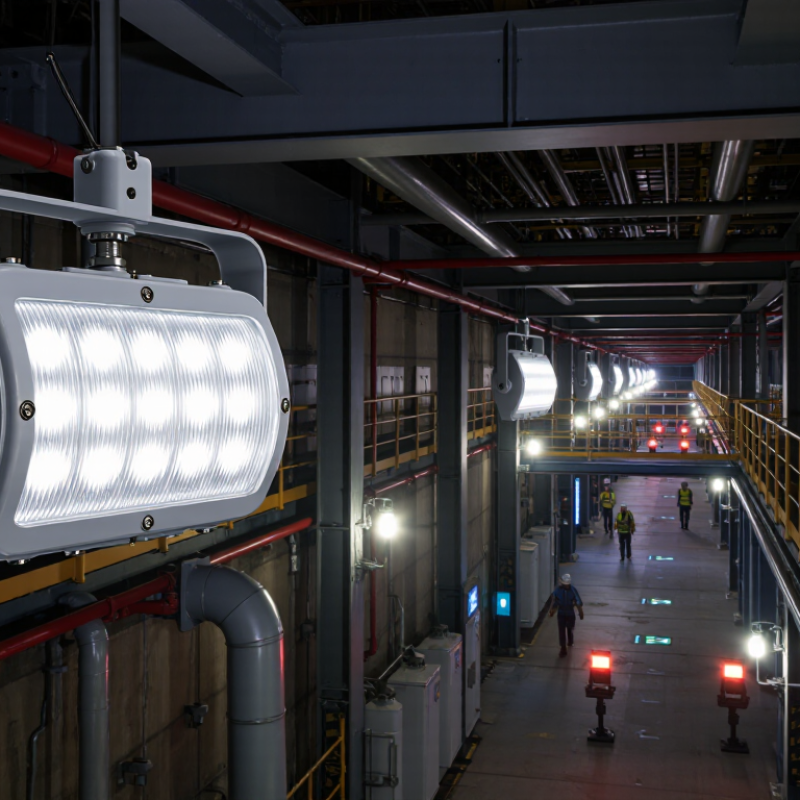
What Explosion-Proof Emergency Lights Are and Where They Are Used
Explosion-proof emergency lights are designed for locations where flammable gas, vapor, or combustible dust may be present. Their enclosures limit the chance that an internal electrical fault will ignite the surrounding atmosphere. They are not simply heavy-duty lamps. Selection depends on the site’s hazardous-area classification, the substances present, and the required temperature rating. Details matter.
During a power failure, an emergency unit uses a battery or backup supply to illuminate exits, stairs, and equipment routes. Think of a dim corridor beside a process line, or a dusty elevator where workers need to find an exit quickly. Common settings include chemical plants, refineries, grain facilities, paint areas, and some wastewater operations.
The U.S. Chemical Safety Board’s 2006 Combustible Dust Hazard Study recorded 281 incidents in the United States from 1980 to 2005, resulting in 119 deaths and 718 injuries. Those figures concern dust incidents, not lighting failures, but they show why ignition control and clear escape routes matter.
Not ordinary fixtures. A certified fitting still cannot compensate for a blocked exit, an untested battery, or a poor maintenance schedule. Choosing the right rating can be less straightforward than it first appears.
Key Safety Standards for Explosion-Proof Emergency Lighting in China
Choosing explosion-proof emergency lighting in China starts with the site’s actual hazard classification. The GB/T 3836 series sets requirements for electrical equipment used in explosive atmospheres, including protection methods and equipment marking. GB 17945-2024 covers fire emergency lighting and evacuation indication systems. Together, these standards help buyers check whether a luminaire suits the area and the emergency function. Verify gas or dust classification, temperature class, ingress protection, battery autonomy, and installation conditions. A certificate alone does not confirm that the selected model fits a particular zone. Small details matter.
NFPA’s report, Fires in U.S. Industrial and Manufacturing Properties, estimated an annual average of 37,910 fires and $1.2 billion in direct property damage during 2011–2015. These figures are not China-specific, but they show why reliable emergency visibility matters when normal power fails. Ask suppliers for current test documentation, clear marking, and evidence that emergency operation was checked after installation. In a plant, a low-mounted fitting may be blocked by stored materials; a bright corridor lamp can still leave a stair turn in shadow. Walk the escape route at night and test the backup supply. One uncomfortable truth: maintenance records are sometimes incomplete. Include battery replacement intervals and periodic function checks in the site’s inspection plan.
China Top 10 Explosion Proof Emergency Light Suppliers - Key Safety Standards for Explosion-Proof Emergency Lighting in China
| No. | Evaluation dimension | Applicable standard or requirement | What to verify | Why it matters |
|---|---|---|---|---|
| 1 | General explosion-protection design | GB 3836.1-2021, Explosive atmospheres — Part 1: Equipment — General requirements | Check that the product’s Ex marking, certificate and technical documentation match the actual light model and configuration. | This is a core reference for explosion-protected equipment used in explosive atmospheres. |
| 2 | Flameproof protection | GB 3836.2-2021, Equipment protection by flameproof enclosures “d” | Where the product uses Ex d protection, verify the certified enclosure, cable entries, fasteners and permitted installation details. | The protection method and installation must be suitable for the hazardous-area application. |
| 3 | Hazardous-area suitability | Applicable parts of the GB/T 3836 series and the project’s hazardous-area classification | Match the equipment protection level, gas or dust group, temperature class and area classification to the site design. | A product’s Ex rating is not universally suitable for every hazardous location. |
| 4 | Electrical installation instructions | GB/T 3836.15-2017, Explosive atmospheres — Part 15: Electrical installations design, selection and erection | Review wiring diagrams, cable-entry requirements, earthing instructions and installation restrictions for the intended site. | Correct equipment selection and installation are both essential to maintaining explosion protection. |
| 5 | Fire emergency lighting system design | GB 51309-2018, Technical standard for fire emergency lighting and evacuation indication system | Check that the proposed emergency-lighting layout, control approach and installation design are coordinated with the project requirements. | Explosion protection does not replace the project’s fire emergency lighting design requirements. |
| 6 | Emergency-lighting product requirements | GB 17945-2024, Fire emergency lighting and evacuation indicating system | Request evidence that the product complies with the applicable edition and requirements for its declared product category. | This standard addresses fire emergency lighting and evacuation indication products; confirm applicability to the specific model. |
| 7 | Certification and regulatory scope | Applicable Chinese explosion-proof product certification and CCC requirements, where required | Check the current regulatory scope, certificate validity, certificate holder, model coverage and issuing body. | Certification obligations depend on the product and current regulations; verify them for the exact product before purchase. |
| 8 | Emergency operation and battery | Applicable product requirements, project specification and approved product documentation | Confirm rated emergency duration, battery type, charging method, replacement procedure and test records against the project specification. | Emergency performance should be verified for the selected model and operating conditions, not assumed from appearance or wattage. |
| 9 | Product traceability and documentation | Certification records, nameplate information, user manual and quality-control documents | Compare the nameplate and model number with certificates, drawings, test reports and the delivered product. | Consistent documentation helps confirm that the delivered configuration is the one evaluated and approved. |
| 10 | Inspection, maintenance and after-sales support | Applicable GB/T 3836 requirements, product instructions and site maintenance procedures | Assess access to inspection guidance, spare parts, battery replacement support and service records for the installed model. | Ongoing inspection and maintenance help preserve product condition and emergency readiness. |
Note: This table summarizes procurement checks, not a ranked supplier list. Confirm the latest standards, certification scope and project-specific requirements with the relevant authorities and qualified technical professionals.
How to Evaluate Explosion-Proof Emergency Light Suppliers
China Top 10 Explosion Proof Emergency Light Suppliers
How to Evaluate Explosion-Proof Emergency Light Suppliers
A supplier’s catalogue is only a starting point. Check that product certificates and test reports match the exact model, enclosure, and battery configuration being offered. Confirm that the equipment suits the hazardous-area classification and conditions at your site. Ask for clear documentation, not just a certificate image. Details matter.
Review the light’s emergency runtime, charging time, operating temperature range, and ingress protection rating. These figures affect performance in real conditions, such as a damp pump room or a hot production area. Ask how each rating was verified and whether replacement batteries and components remain available. A sample inspection can reveal loose cable entries, unclear labels, or awkward access for maintenance.
Evaluate the supplier’s quality controls, delivery consistency, and after-sales support. Ask how production batches are traced and how faults are handled. Compare responses to specific questions; vague answers deserve follow-up. No checklist catches everything. Even a strong document package cannot replace checking the delivered unit against its approved specifications. Record unanswered questions before placing an order, and confirm the intended installation environment with a qualified site professional.
Profiles of 10 Chinese Explosion-Proof Emergency Light Suppliers
The ten supplier profiles should be compared by what they actually build, not by catalogue language alone. One may focus on LED emergency units for dusty workshops; another may specialize in compact fittings for narrow service corridors. Other profiles include enclosure makers, custom-design manufacturers, export-focused producers, and suppliers serving mining, chemical, or port facilities. Some offer battery packs and control components in-house, while others source them externally. That difference can affect lead times and replacement-part consistency. Details matter.
A useful profile also shows how each supplier handles practical checks. Look for clear product drawings, stated operating temperatures, battery backup figures, and test records tied to the offered model. Ask how samples are inspected, how seals are checked, and whether the production unit matches the sample. A bright showroom photo proves little. For example, a gasket may appear seated in a sample but shift during repeated assembly. Not every supplier explains this well. Comparing ten profiles side by side can reveal who provides traceable technical information and who leaves important questions unanswered. Some details may still need direct confirmation.
How to Compare Supplier Products, Certifications, and Services
When comparing China’s top 10 explosion-proof emergency light suppliers, start with the application, not the catalog photos. Check the hazardous-area classification, ambient temperature range, ingress protection, and emergency runtime. A fixture that looks suitable may not match the site’s conditions. Ask suppliers for test reports and technical data tied to the exact model, not a similar product. A polished brochure is not proof. Confirm that certificates are current, issued by a verifiable body, and relevant to the destination market. Requirements can differ by project, so have a qualified safety professional review the selection.
Product details matter. Look at battery type, charging time, lumen output in emergency mode, and stated service life. Request clear answers on replacement parts and maintenance intervals. A sample can reveal practical issues, such as awkward mounting points or unclear wiring labels. It may not reveal long-term reliability, though. Compare service response times, warranty terms, customization limits, and spare-part availability in writing. Ask how the supplier handles failed units and documentation updates. If answers arrive slowly before an order, consider how support may feel after installation. Price still counts, but an unexplained gap deserves questions, not assumptions. One comparison sheet helps; it cannot replace careful verification.
China Top 10 Explosion Proof Emergency Light Suppliers — How to Compare Supplier Products, Certifications, and Services
This chart is a suggested evaluation framework, not a ranking or verified assessment of specific suppliers. Compare product performance and documentation, confirm that certificates are valid and cover the exact product and hazardous-area classification, and assess customization, delivery, and after-sales support using the same evidence-based checklist.
