
China Top Industrial Motherboard Suppliers for Global Buyers

China has become a major sourcing hub for Industrial Motherboard solutions used in factories, transport systems, medical equipment, and energy projects. Global buyers often seek stable performance, long service life, and flexible customization. The right supplier must provide more than a competitive quotation. Technical support matters.

Experienced manufacturers typically offer boards with extended temperature ranges, multiple expansion slots, and reliable interfaces such as COM, LAN, USB, and GPIO. These details become important inside dusty control cabinets or compact automation systems. A professional supplier should explain chipset selection, storage compatibility, BIOS options, and expected product availability. Clear documentation reduces integration delays.

Still, no supplier is perfect.

Buyers should review factory experience, quality procedures, sample results, and after-sales response before signing a contract. ISO certifications can support credibility, but certification alone does not prove every product will meet a project’s needs. Ask for thermal test data, vibration information, lifecycle planning, and traceable quality records. Site audits or video inspections may reveal practical details, including assembly discipline and testing equipment.

This guide examines leading China Industrial Motherboard suppliers from a global purchasing perspective. It considers product range, engineering capability, customization services, communication, and delivery reliability. The evaluation is not based only on polished websites or broad claims. Real performance depends on the application, environment, and supplier cooperation.

Some information may change.

Therefore, buyers should confirm current specifications and certifications directly with each manufacturer. A careful comparison can help companies reduce technical risk, control total ownership costs, and build longer-lasting industrial systems.
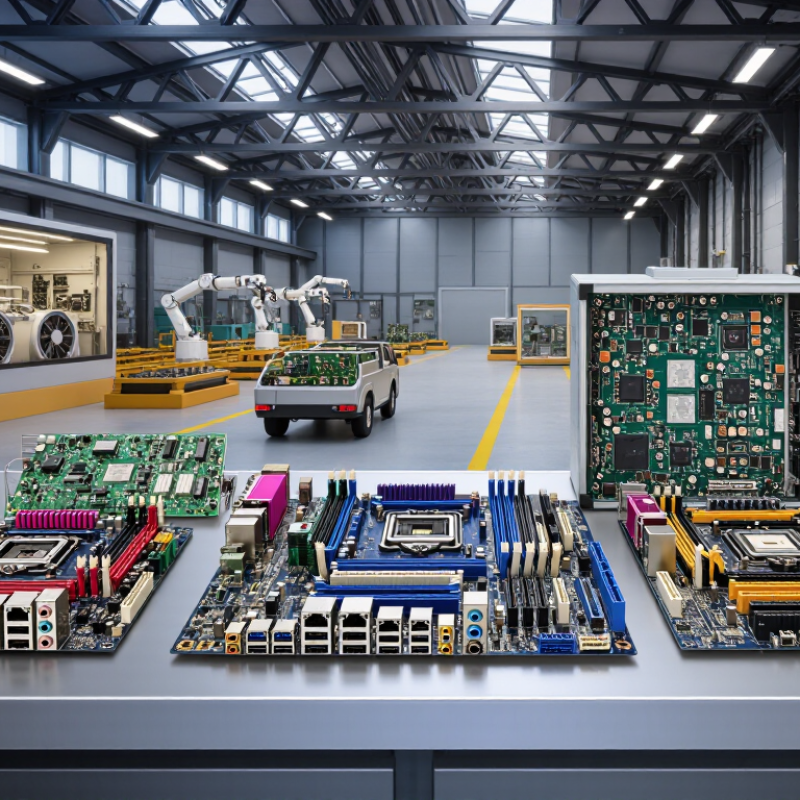
China Top Industrial Motherboard Suppliers for Global Buyers

Industrial Motherboards: Form Factors, Functions, and 24/7 Applications

Industrial motherboards are built for machines that cannot afford casual downtime. ATX boards suit expansion-heavy systems, while MicroATX and Mini-ITX fit compact control cabinets. COM modules support modular designs, but carrier-board compatibility requires careful checking. A practical selection starts with I/O needs, not board size. Serial ports, GPIO, LAN, USB, display outputs, and storage interfaces should match the machine’s real workload.

Functions determine reliability during continuous operation. Look for watchdog timers, ECC memory support, TPM security, remote monitoring, and fan-control options. Wide-temperature components help equipment survive hot cabinets and cold production floors. According to IoT Analytics, connected IoT devices reached about 16.6 billion in 2023, with approximately 18.8 billion expected in 2024. More endpoints mean more gateways, inspection systems, and edge computers operating around the clock.

Thermal design remains easy to underestimate. A sealed cabinet may look clean, yet heat accumulates beside drives and power supplies. Industrial PC market research from MarketsandMarkets projects continued growth through 2028, driven partly by automation and edge computing. The numbers are encouraging, but forecasts are not guarantees. No motherboard is perfect. Engineers should test vibration, boot recovery, storage endurance, and long-duration thermal performance before deployment. Small details matter. A failed watchdog setting can stop an entire production cell.

Industrial Motherboard Form Factors for 24/7 Applications

Standard form factors differ significantly in board area, affecting expansion capacity, enclosure size, cooling design, and suitability for continuous-use systems such as industrial automation, edge computing, medical equipment, and transportation control.

China’s Top Supplier Types: OEM, ODM, and 5–15-Year Lifecycle Support

China’s industrial motherboard suppliers generally serve global buyers through OEM, ODM, or long-term lifecycle programs. OEM production follows an existing design, while ODM teams can adjust the board layout, I/O ports, BIOS, and thermal structure. This matters when a factory needs dual LAN ports, isolated serial interfaces, or a wide-temperature design. According to MarketsandMarkets’ 2024 Industrial PC Market report, the sector is projected to grow at roughly 6% annually through 2029. Buyers therefore need more than a low initial quotation.

An experienced supplier should define a 5–15-year support plan before mass production. The plan should cover component selection, approved substitutions, revision control, repair procedures, and final-order notices. WSTS reported that global semiconductor sales were forecast to rise 16% in 2024, reaching about 611 billion dollars. Such market movement can affect availability and pricing. A supplier with multi-source validation can reduce that exposure. Still, “lifetime support” is sometimes vague. Ask for written terms, annual availability targets, and a clear last-time-buy process.

For an OEM project, buyers should inspect production records, burn-in methods, and failure-analysis reports. For ODM work, review prototype evidence, thermal test data, and BIOS update controls. A five-year promise may fit office automation, but railway, medical, or factory systems can require fifteen years. That assumption needs testing. One overlooked connector can force a redesign. Pilot batches, sample audits, and quarterly engineering reviews make the partnership more reliable.

Supplier Quality Benchmarks: ISO 9001, IPC-A-610, and Reported 50,000h MTBF

China Top Industrial Motherboard Suppliers for Global Buyers

Quality evidence starts with a certificate, but it cannot end there. The ISO Survey 2023 recorded 1,265,216 valid ISO 9001 certificates across 189 countries and economies. This figure shows broad adoption, not automatic product quality. Buyers should request the certificate scope, audit date, corrective-action records, and production-site address. A certificate covering office administration alone offers limited protection. Check the details.

IPC-A-610 provides visual acceptance criteria for electronic assemblies, including solder joints, component placement, and cleanliness. It is not a substitute for engineering validation. Ask suppliers to define Class 2 or Class 3 requirements before sampling. Request inspection photographs, traceability records, and a recent first-article report. In practice, these details reveal more than a polished presentation. Small documentation gaps deserve attention.

A reported 50,000-hour MTBF sounds impressive, yet it means roughly 5.7 years only as a statistical measure. It does not promise five years of uninterrupted service. MTBF depends on temperature, voltage, workload, component quality, and calculation method. Reliability predictions should identify the model, test conditions, sample size, and failure definition. IEC TR 62380 and Telcordia SR-332 are commonly referenced methods, but their assumptions differ. I would treat an unsupported MTBF number as incomplete evidence. Suppliers should provide burn-in results, thermal-cycle data, and field-failure trends where available. Even then, uncertainty remains. That is the honest part.

Core Technical Metrics: -20–70°C Operation, PCIe, 5G, and 10G Expansion

For global buyers, an industrial motherboard must survive more than a laboratory test. A −20–70°C operating range supports outdoor cabinets, factory lines, and unheated control rooms. However, temperature ratings can hide weaknesses in storage, power delivery, or connector aging. Buyers should request thermal logs, burn-in records, and test conditions.

PCIe remains important for vision cards, motion control, and data acquisition. PCI-SIG data shows PCIe 4.0 x16 can deliver about 31.5 GB/s of bidirectional bandwidth. Lane allocation matters. A board with several slots may reduce each slot’s speed under load. That detail is easy to miss.

GSMA Intelligence forecasts 1.6 billion global 5G connections by the end of 2025. Industrial gateways therefore need reliable 5G support, strong antenna routing, and stable operation near electrical noise.

10GbE expansion helps move inspection images, sensor streams, and machine records without creating a narrow network path. The Ethernet Alliance identifies 10GbE as a practical step for bandwidth-heavy enterprise and industrial networks. Yet peak throughput is not guaranteed. Cable quality, thermal throttling, driver maturity, and packet workload can reduce performance. Suppliers should provide measured results, not only interface labels. Independent verification against IEC environmental testing practices adds confidence, although test coverage is rarely perfect. Examine the gaps.

Global Purchasing Criteria: CE, RoHS, IEC 62368-1, MOQ, and Lead Times

China Top Industrial Motherboard Suppliers for Global Buyers
Global Purchasing Criteria: CE, RoHS, IEC 62368-1, MOQ, and Lead Times

Global buyers should treat compliance documents as purchasing evidence, not decorative attachments. For CE, request the EU Declaration of Conformity, applicable directives, and technical file references. CE marking is usually the manufacturer’s declaration, not a universal quality certificate. RoHS documentation should identify restricted substances, material controls, and supplier traceability. For IEC 62368-1, confirm the tested product configuration, safety reports, and relevant edition. Check the edition.

MOQ can change significantly when buyers request customized BIOS settings, connectors, memory, or enclosure dimensions. Ask whether the MOQ applies to samples, standard boards, or fully customized production. Small pilot orders reduce technical risk, but they may carry higher unit costs. That trade-off needs visibility. Lead times should be separated into engineering, component procurement, assembly, testing, and shipping. A quoted 20-day lead time may exclude component allocation or final inspection. Buffers matter.

Before approval, inspect serial-number control, incoming inspection records, and burn-in procedures. Verify that certificates match the exact model and revision. A video audit can reveal storage conditions, test equipment, and process discipline. In practical sourcing, complete-looking files can still hide outdated reports or unverified subcontracting. Ask uncomfortable questions. Some requirements will be missed. Buyers should record corrective actions, acceptance limits, and delivery milestones in the purchase contract.