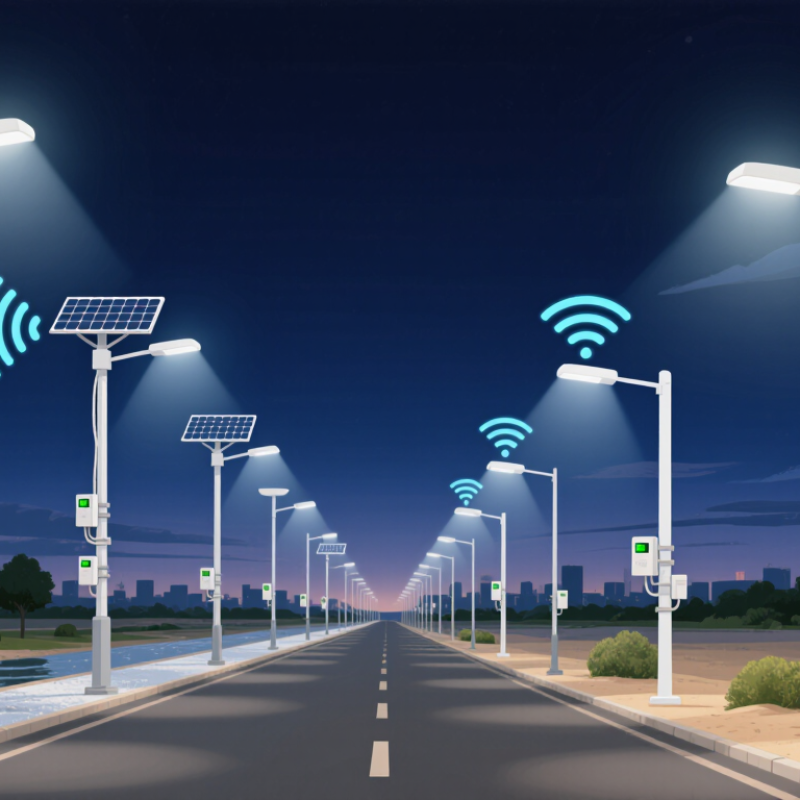
10 Best Smart Street Lights for Global Buyers in 2026
A Smart Street Light can do far more than illuminate a road. It can support dimming schedules, remote fault alerts, and energy monitoring. For global buyers, the challenge is matching these features to local streets, climates, budgets, and maintenance capacity. A coastal road with salt spray has different needs from a dry inland avenue. The right choice depends on the installation, not just the product brochure. Datasheets help, but they rarely show every field condition. Small details matter: connector types, surge protection, access to replacement parts, and the clarity of the control platform.
This guide compares ten smart street-light options for buyers planning projects in 2026. It considers practical factors such as light distribution, energy performance, control compatibility, durability, and supplier support. No shortlist is perfect. Product specifications can change, and performance may vary with pole height, road layout, and installation quality. Buyers should confirm current certifications and test reports directly with manufacturers. Ask for a sample configuration, warranty terms, and a clear plan for commissioning and repairs. Compare the total project cost, not only the fixture price. Look closely at how systems handle network outages and software updates. Details matter. Markets differ, and a feature that works well in one city may add little value elsewhere. Use the comparison as a starting point, then verify each option against your site conditions and procurement requirements.
What Smart Street Lights Are and How They Work
A smart street light is more than an LED fixture with a timer. It combines a light source, a control unit, and often sensors or a communications connection. A photocell can detect dusk, while a motion sensor may register activity near a road or walkway. The controller then adjusts brightness according to programmed rules. That sounds simple. In practice, reliable performance depends on careful installation and sensible settings.
Many systems send operating information to a central platform through a wireless or wired network. Staff can check whether a lamp is working, review energy use, and change schedules without visiting every pole. Some lights dim during quiet hours and brighten when movement is detected. The exact response depends on sensor range, road layout, and local conditions. Rain, tree cover, and nearby traffic can affect readings, so field testing matters.
Smart controls can help reduce wasted electricity, but savings are not automatic. Poor schedules may leave streets too dim or lights unnecessarily bright. Network outages also matter: each fixture should have a safe fallback setting rather than relying on constant connectivity. For buyers, ask how the system handles faults, protects access to control data, and reports failures. A clear maintenance plan is just as important as the hardware. One detail is easy to overlook: older poles may need electrical or network upgrades before new controls work well.
How to Assess Smart Street Lights for Global Use
Choosing smart street lights for global use starts with the street, not the catalogue. Measure road width, mounting height, pole spacing, surface conditions, and pedestrian activity. Request photometric files and test them against an actual street layout. Lumen claims alone can hide dark patches or uneven coverage. Keep glare and light spill in view. Small details matter.
Check whether the light suits local power conditions and expected weather. Compare its operating voltage, surge protection, temperature range, and enclosure rating with the installation site. Coastal roads may need stronger corrosion protection; dusty, hot areas can challenge seals and heat management. Ask how drivers, control units, and sensors can be replaced. A practical assessment includes spare-part availability, clear service instructions, and warranty terms—not just a long rated lifetime.
Controls need equal attention. Confirm dimming schedules, fault alerts, and compatibility with the planned management system. Ask who owns the data and how the network behaves if communication fails. A short pilot can expose poor coverage, confusing setup, or maintenance issues before a large order. Measure power use and light levels on site, then compare results with the supplier’s figures. Not every feature earns its cost. I would still leave room for doubt: one successful test cannot represent every climate or road. Evaluate local requirements with qualified professionals before deployment.
10 Best Smart Street Lights for Global Buyers in 2026
For global buyers in 2026, the best smart street lights are not simply the brightest fixtures. They balance road visibility, energy use, maintenance needs, and local climate. A coastal road may need strong corrosion resistance, while a cold inland site needs dependable starting and dimming performance. Small details matter. Check light distribution, not just wattage; a narrow beam can leave dark patches between poles.
Useful options include adaptive LED heads, solar-powered units, networked fixtures, and models with motion or traffic-based dimming. Each suits different conditions. Solar systems can simplify remote installations, but shade, battery capacity, and cloudy seasons affect real output. Networked controls help crews adjust schedules and spot outages, though weak connectivity can limit their value. Ask for photometric files, ingress-protection ratings, operating-temperature ranges, and clear warranty terms. These documents make comparisons more practical than polished product photos.
A sensible shortlist should include ten candidates with different control methods and power configurations, rather than ten near-identical fixtures. Compare expected maintenance access, spare-part availability, and the cost of replacing batteries or control modules. Not always. A more advanced system may be harder to repair locally. Pilot a few lights on a representative road, then inspect illumination, glare, and control response after real weather and traffic. Results may challenge the original specification, and that is useful evidence for a better purchase.
How Leading Models Compare in Features and Performance
Smart street lights in 2026 differ less by appearance than by how well their controls fit local streets. Some leading models combine LED fixtures, motion sensors, and remote dimming. Others focus on dependable schedules and straightforward maintenance. A controller that dims an empty road and brightens when traffic approaches can reduce wasted light, but sensor placement matters. A tree canopy or parked truck may interfere. Small details matter. Compare lumen output, color temperature, and optics together; a bright fixture with poor beam control can spill light into windows.
Performance also depends on the network and the people maintaining it. Cellular, mesh, and wireless links each suit different layouts, so check coverage at intersections and along long road sections. Ask how the system behaves during an outage. Does it keep a safe preset, or wait for a connection? Some models report energy use and faults by fixture, which helps crews find a failed unit without driving every block. Yet dashboards can make a system look easier than it is. I may be giving remote monitoring too much credit: crews still need accessible poles, clear fault alerts, and spare parts. Compare warranty terms and service response times, not just advertised efficiency. A pilot installation on one representative street can reveal glare, weak signals, and awkward controls before a larger rollout.
How to Select a Smart Street Lighting System for Your Project
A smart street lighting system should match the road, not just the product specification. Map road width, pole spacing, mounting height, traffic patterns, and nearby homes before comparing fixtures. These details affect light distribution and glare. A narrow residential street may need different optics from a wide arterial road. Check local lighting requirements and request photometric files to assess coverage. Good numbers matter.
Next, define what “smart” needs to mean for your project. Dimming schedules can reduce energy use, while remote monitoring can flag outages without routine night inspections. Confirm how controllers communicate, whether the network suits the site, and how the system will integrate with existing equipment. Ask about cybersecurity, software updates, data access, and ongoing service costs. Connectivity may look simple on a diagram, but signal strength can vary between blocks.
Finally, compare total ownership costs, not only purchase prices. Review expected energy savings, warranty terms, spare-part availability, and maintenance procedures. Request a pilot installation on a representative section of road. Measure light levels, check sensor responses, and ask maintenance crews to test the controls. A trial may expose awkward settings or uneven coverage. That can be inconvenient, but changing a small installation is usually easier than correcting an entire network. Keep the results, including problems, in the project record.
10 Best Smart Street Lights for Global Buyers in 2026 - How to Select a Smart Street Lighting System for Your Project
This comparison covers common system architectures rather than branded products. Suitability depends on local regulations, network availability, pole infrastructure, climate, and project requirements. Confirm interface compatibility and performance with suppliers before procurement.
| System Option | Control and Connectivity | Typical Interface or Standard | Best-Fit Applications | Main Advantages | Key Considerations | Buyer Checks |
|---|---|---|---|---|---|---|
| 1. Photocell and scheduled dimming | Local dusk-to-dawn switching with preset dimming schedules; no remote network required. | Photocontrol receptacle and a compatible dimming driver; verify the control method used by the luminaire. | Small deployments, rural roads, and projects where remote monitoring is not required. | Simple architecture, limited communications infrastructure, and straightforward operation. | Does not normally provide centralized fault alerts, live status, or remote schedule changes. | Confirm photocell compatibility, dimming behavior, surge protection, and local switching requirements. |
| 2. Central management with cellular nodes | Individual luminaires communicate with a management platform over a cellular network. | A compatible luminaire controller; some installations use a seven-pin control receptacle conforming to ANSI C136.41. | Projects needing remote monitoring without installing a private radio network. | Can support remote scheduling, status reporting, and fault notifications where cellular service is available. | Coverage, subscription terms, roaming, and device support vary by country and operator. | Check coverage at pole locations, supported cellular bands, SIM management, data costs, and platform export options. |
| 3. Zhaga-D4i-ready control system | Interoperable luminaire and controller components designed for connected lighting applications. | Zhaga Book 18 interface with applicable D4i requirements; confirm the specific luminaire and node certifications. | New installations prioritizing replaceable controllers and standardized luminaire interfaces. | A standardized interface can simplify component replacement and multi-vendor procurement. | An interface alone does not guarantee end-to-end compatibility with every control platform or feature. | Verify the exact Zhaga and D4i conformity, supported sensors, dimming functions, and controller-to-platform compatibility. |
| 4. LoRaWAN gateway-based network | Low-power radio nodes send data to one or more gateways, which connect to the network server. | LoRaWAN; gateway placement and radio settings must suit local spectrum rules and site conditions. | Municipal or campus projects with planned gateway locations and modest device data needs. | Designed for low-power, low-bandwidth communications and can use a privately managed network. | Coverage depends on buildings, terrain, antenna placement, interference, and regional radio regulations. | Request a radio survey, confirm gateway backhaul and redundancy, and check regional frequency-plan compliance. |
| 5. NB-IoT-connected lighting | Low-power cellular IoT connectivity through a participating mobile network operator. | NB-IoT modem and an operator-supported SIM or embedded SIM; availability is market-dependent. | Distributed installations where NB-IoT service is available and device data requirements are modest. | Uses cellular IoT infrastructure and avoids the need for a project-owned radio gateway network. | Operator availability, network coverage, roaming, service terms, and latency can differ between markets. | Confirm local NB-IoT service, device certification, indoor or pole-level coverage, and long-term operator support. |
| 6. LTE-M-connected lighting | Cellular IoT communication with support determined by the modem, operator, and network deployment. | LTE-M-capable controller and an operator-supported SIM or embedded SIM. | Projects that need cellular connectivity and may require more responsive communication than a low-data-only design. | Can provide direct cellular communication without a local gateway, subject to network availability. | LTE-M support and coverage are not uniform across countries or operators; service plans may be required. | Check LTE-M band support, operator certification, roaming policy, data plan, and replacement options for the modem. |
| 7. Power-line communication (PLC) | Control and status data travel over electrical conductors, with system components dependent on the chosen PLC design. | Compatible PLC controllers, concentrators, and management software; interoperability is implementation-specific. | Projects where power-line infrastructure and electrical distribution topology are suitable for PLC. | May reduce the need for a separate wireless radio link at each luminaire. | Signal performance can be affected by wiring layout, electrical noise, transformers, and network segmentation. | Require an on-site communications assessment and verify compatibility with the project’s electrical network. |
| 8. Wi-Fi mesh lighting network | Nodes communicate over a Wi-Fi-based network, with gateways or access points providing backhaul. | Wi-Fi hardware and networking configuration selected for the deployment; check supported frequency bands. | Dense campuses, industrial sites, or districts with existing managed Wi-Fi infrastructure. | Can make use of existing network resources when coverage and security policies allow. | Coverage, interference, cybersecurity management, and backhaul capacity need careful planning. | Assess pole-level signal strength, network ownership, device onboarding, security updates, and access-point capacity. |
| 9. Mesh network with cellular backhaul | Nearby luminaires exchange data over a local mesh; selected gateways connect the mesh to a remote platform over cellular service. | Mesh nodes and gateways using a compatible radio protocol; cellular connectivity at gateway locations. | Areas where local nodes are close enough for mesh communication but wired backhaul is limited. | Can reduce the number of cellular connections required compared with direct cellular connectivity at every pole. | Mesh performance depends on node spacing, obstacles, gateway placement, and network design. | Request a coverage and resilience plan, including gateway failure behavior and cellular backhaul costs. |
| 10. Solar off-grid smart lighting | Photovoltaic panels and batteries power the luminaire; monitoring and control may use cellular, LoRaWAN, or another supported link. | Solar charge controller, battery, luminaire driver, and a compatible optional communications controller. | Remote locations without practical grid access, subject to adequate solar resource and maintenance access. | Can operate independently of a utility connection when correctly sized for the site and load. | Required panel and battery capacity depend on solar resource, autonomy target, operating schedule, temperature, and load. | Review a site-specific energy calculation, battery service life, winter performance, shading, and component replacement plan. |