What is an AC Servo Motor and How Does it Work?
The AC servo motor is a key component in modern automation and robotics. Its precision and efficiency make it vital for industries such as manufacturing and aerospace. According to a recent report by Research and Markets, the global AC servo motor market is expected to grow by over 10% annually from 2022 to 2027. This growth highlights the increasing demand for high-performance motion control systems.
Industry expert Dr. Emily Chen states, "The evolution of AC servo motors has revolutionized automation." Her insight reflects the profound impact these motors have had on improving productivity and reliability in various applications. However, challenges remain. While AC servo motors offer significant advantages, their complexity often leads to over-engineering. Many companies still struggle with integration issues, which can limit their effectiveness.
The AC servo motor’s technology is impressive, yet it demands expertise for proper implementation. Understanding how these motors work allows for better decision-making in automation strategies. Yet, organizations must remain vigilant. Over-reliance on technology could lead to skill gaps in the workforce. This balance is crucial as industries continue to evolve.

What is an AC Servo Motor?
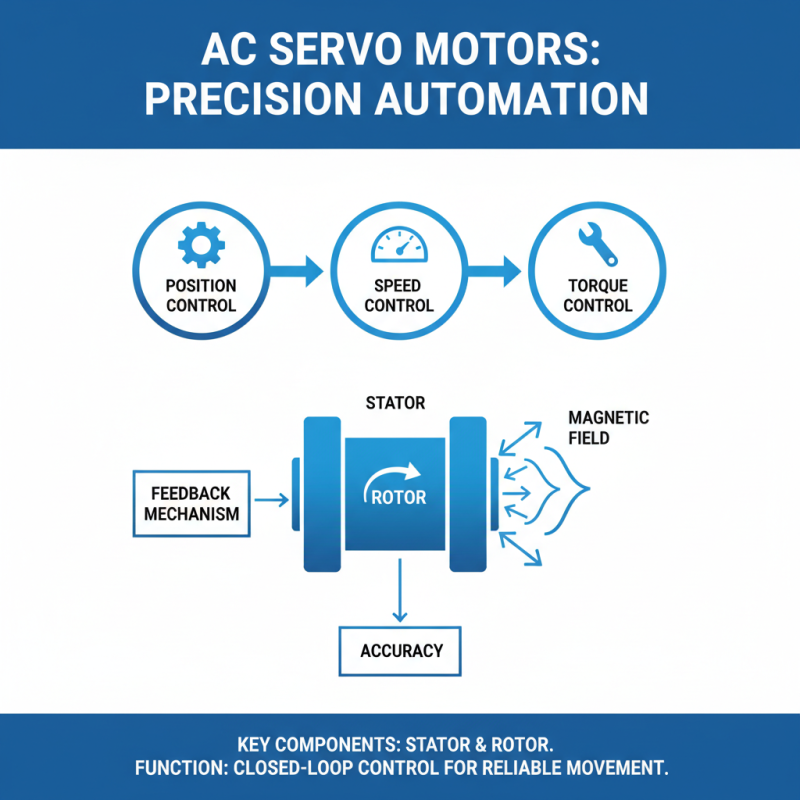
An AC servo motor is a type of electric motor. It utilizes alternating current and is used for precise control of angular position and speed. These motors are commonly found in robotics and automation systems due to their efficiency. They consist of a stator and rotor that work together to create precise movements.
The operation of an AC servo motor involves feedback systems. These systems monitor the motor's position and speed. Sensors send data to a controller, which makes adjustments as necessary. This closed-loop system ensures accuracy.
Tips: Consider your application needs when selecting a motor type. Not all applications require the same level of precision.
AC servo motors are generally more complex than other motors. They require proper tuning for optimal performance. Without this, the system may face issues. Be aware that improper installation can lead to inefficiency.
Tips: Always follow installation guidelines. They help prevent common pitfalls. Understand the limitations of your motor. This knowledge will improve your project outcomes.
Key Components of an AC Servo Motor
AC servo motors are vital in automation and robotics. Understanding their key components can enhance efficiency in various applications. The main components include the stator, rotor, feedback device, and drive electronics. The stator generates a rotating magnetic field when electrical current passes through its windings. This magnetic field is crucial for the motor's operation.
The rotor is the component that moves. It interacts with the magnetic field from the stator. This interaction causes the rotor to spin, producing mechanical motion. In high-performance applications, precision is key. A feedback device, often an encoder, continuously monitors the rotor's position. This information helps the drive electronics adjust the motor's torque and speed in real-time.
Tips: Choosing the right feedback device can significantly boost motor performance. Look for one that matches your system requirements. Also, remember that not all systems need the same level of precision. Evaluate your needs to avoid overspending on unnecessary features.
Drive electronics are another crucial feature. They control the motor by supplying power based on the feedback received. It's essential to ensure compatibility between the motor and the drive to optimize performance. However, poor integration can lead to inefficiencies. Always conduct a thorough analysis before implementation.
How AC Servo Motors Operate: A Step-by-Step Guide
AC servo motors are vital in automation. They provide precise control of position, speed, and torque. These motors use feedback mechanisms to ensure accuracy. Typically, they consist of a stator and a rotor. The stator generates a magnetic field, while the rotor receives this energy, allowing for movement.
Operation begins when a control signal is sent to the motor. The control system adjusts the current in the motor windings. This influences the magnetic field, which in turn moves the rotor. According to a 2022 report from *Research and Markets*, the global AC servo motor market is expected to grow significantly, with a 7.02% CAGR from 2022 to 2027. This growth reflects the increasing demand in industries like robotics and CNC machines.
However, AC servo motors are not without challenges. They can be complex to set up and tune. Timing the feedback loop accurately is critical. If not, the motor may underperform or oscillate. These imperfections serve as reminders that even advanced technologies require careful handling and ongoing improvement.
Applications of AC Servo Motors in Various Industries
AC servo motors have become integral in various industries. These motors provide precise control, making them ideal for applications in robotics, manufacturing, and automation. According to a recent market analysis, the global AC servo motor market is projected to reach $14.5 billion by 2026, growing at a CAGR of 6.5%. This growth reflects the increasing demand for automation across sectors.
In robotics, AC servo motors enable accuracy and high performance. They allow robotic arms to perform intricate tasks with speed and precision. For example, in the automotive industry, these motors assist in assembly lines, speeding up production while minimizing errors. Data from industry reports indicate that automakers are increasingly investing in servo-driven systems to enhance efficiency.
However, not all applications achieve the expected efficiency. Sometimes, the integration of AC servo motors can be challenging. Specific setups may lead to oversizing or underutilizing the motor's capabilities. This often results in increased operational costs. Companies must carefully assess their needs to avoid these pitfalls. In doing so, they can truly harness the potential of AC servo motors in their operations.
Advantages and Challenges of Using AC Servo Motors
AC servo motors offer distinct advantages in precision and efficiency. These motors excel in applications requiring high accuracy and rapid response. A report by MarketsandMarkets predicts the AC servo motor market will reach $16.35 billion by 2025, growing due to increasing demand for automation across various sectors. Their ability to maintain consistent speed and torque under varying loads is impressive. This makes them ideal for robotics and CNC machinery.
However, there are challenges to consider. AC servo motors can be more complex and expensive than traditional motors. Installation and maintenance require skilled technicians, adding to overall costs. Furthermore, they may not perform as well in high-temperature environments. Data from the International Society of Automation highlights that despite their efficiencies, up to 30% of users face operational difficulties. This calls for a careful assessment of application needs before integrating AC servo motors into systems. The balance of advantages against these challenges is crucial for manufacturers looking to optimize performance.